Signs Your Service Business Website Needs a Redesign
If your website is losing you leads, it might be time for a redesign. Here are the clearest signs your service business site is working against you.
Most service business owners don’t wake up one morning and think “my website is broken.” The decline is gradual. Traffic thins out. The phone rings a little less. Someone mentions they found a competitor online instead. But the website has been there the whole time, looking more or less like it always has, so it doesn’t get the blame.
The problem is that a website doesn’t have to crash to stop working. It can quietly cost you leads every single day without showing any obvious symptoms. This post walks through the clearest signs that your site has crossed the line from “good enough” to “actively hurting the business,” and what a redesign actually fixes.
Your site looks noticeably older than your competitors
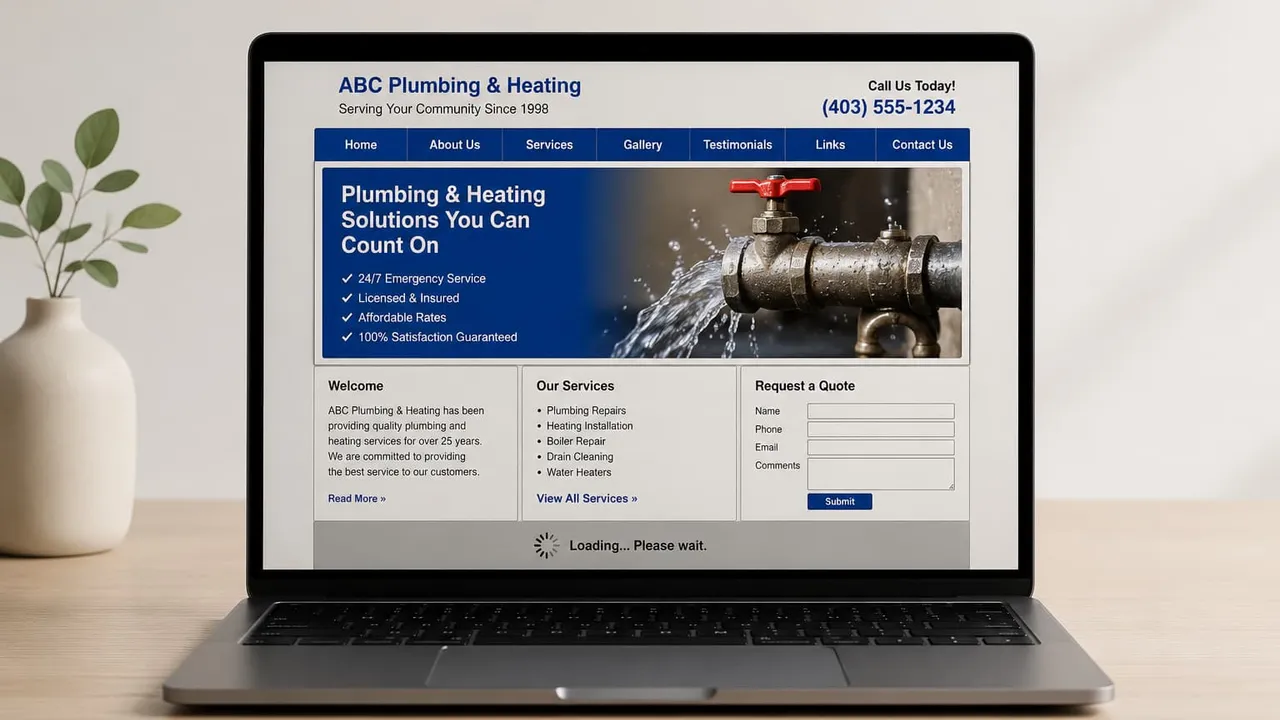
This one is hard to see on your own because you look at your own site constantly. Open a competitor’s website beside yours. If theirs reads as polished and current while yours looks dated (the layout feels cramped, the fonts are small, the images are stock photo-generic), that gap matters more than you might think.
Visitors make a snap judgement about your credibility in the first few seconds. A site that looks like it was built in 2014 signals, fairly or not, that the business behind it hasn’t been paying attention. In a category where trust is the whole sale (hiring a contractor, choosing a clinic, booking a professional service), that first impression can end the conversation before it starts.
Design trends do change, and chasing every one of them is pointless. But there’s a difference between a site that’s “unfashionable” and one that genuinely looks neglected. If yours falls into the second category, a redesign isn’t vanity: it’s a credibility repair.
It doesn’t work properly on mobile
More than half of web traffic is now on phones. For local service searches (“plumber near me,” “physiotherapy Calgary”), that number is even higher, because people search from wherever they are when the problem happens.
If your website was built before 2018 and hasn’t been updated since, there’s a real chance it renders poorly on mobile: small text that requires pinching and zooming, navigation that doesn’t collapse into a usable menu, buttons too small to tap with a thumb, images that overflow the screen. None of this stops the page from loading, so you might not have noticed it. But your mobile visitors have.
A site that’s uncomfortable to use on a phone doesn’t just frustrate visitors. Google treats mobile experience as a ranking signal. A poor mobile experience can suppress your search visibility at the exact moment people are most likely to be looking for you.
It loads slowly
Page speed is one of the most direct links between your website and your conversion rate. Google’s own research has found that as load time increases from one second to three seconds, the probability that a visitor leaves before the page even appears rises significantly. On a mobile connection, the effect is even more pronounced.
The technical term for how Google measures this is Core Web Vitals: a set of metrics that capture how fast a page loads, how stable it is while loading (does the layout shift and jump around?), and how quickly a visitor can interact with it. A site that scores poorly on these doesn’t just lose visitors. It ranks lower in search results.
Most older websites weren’t built with modern performance standards in mind. They rely on oversized images, old JavaScript libraries, and page structures that were fine in 2015 but look sluggish next to a well-optimized modern site. If you’ve ever looked at your own site and noticed it takes a few seconds to load, that’s lost leads, not a minor annoyance.
It’s hard to update and you’ve stopped trying
A website that’s painful to edit ends up not being edited. If making a simple change (updating your hours, swapping out a photo, changing a service description) requires waiting on a developer or navigating a confusing backend, the site starts to drift from reality.
Outdated information erodes trust in ways that are hard to recover from. A phone number that doesn’t work, a service you no longer offer, pricing that’s well below current rates. These details signal to a potential client that no one is minding the business. It also creates operational headaches when someone calls about something you stopped doing two years ago.
A well-built modern site should let the business owner make routine content changes without touching code. If that’s not true of your current site, it’s worth factoring into a redesign brief.
Your bounce rate is high and time on page is low
If you have Google Analytics (or any analytics) set up, two numbers tell you a lot: bounce rate and average time on page. A high bounce rate means most visitors leave after viewing only one page. A short average session length means they didn’t stick around long enough to learn much.
These numbers are never perfect indicators on their own. A single-page site has a naturally high bounce rate. Informational content gets skimmed. But if your service pages (the pages that are supposed to convert visitors into enquiries) show high bounce rates and sessions under 30 seconds, something is breaking the visitor’s attention or trust quickly.
Common causes: the page takes too long to load and they give up, the design looks untrustworthy, the message doesn’t match what they searched for, or it’s simply unclear what you do and who you serve. A redesign addresses these structurally, not just cosmetically.
The site doesn’t clearly answer “what do you do and who is it for”
Spend ten seconds on your own homepage as if you’ve never seen it before. Can you tell, immediately, what the business does, who it serves, and what the next step is?
If your homepage leads with a welcome message, a wall of company history, or a vague tagline, it’s failing at its primary job. A service business website has one main function: take a visitor with a problem and guide them toward contacting you. Every element on the page either supports that or gets in the way.
The clearest sites say something like: “We build websites for Alberta tradespeople that generate real leads.” The reader knows within seconds whether they’re in the right place. If your site requires visitors to explore around to figure out what you do, most of them won’t bother.
You’re getting traffic but very few leads
This is one of the more frustrating situations: Google Search Console shows impressions and clicks, but the phone doesn’t ring and the contact form barely gets used. Traffic without leads is a conversion problem, not a traffic problem.
A few common causes: the contact form is buried at the bottom of a long page or requires too many fields, the phone number isn’t clickable on mobile, the call to action is vague (“learn more” instead of “get a free quote”), or there’s no clear reason on the page for a visitor to act now rather than keep looking.
These aren’t problems that get fixed by writing more blog posts or running ads. They’re structural, and they’re fixed through a redesign that treats lead capture as the primary design goal, not an afterthought.
For a complete overview of what a redesign involves and what is included, see our website redesign services page.
The site was built for a business that’s changed
Service businesses evolve. You drop services, add them, move into new markets, change your pricing model, bring on staff. If your website was built to represent the business as it was three or four years ago and hasn’t been updated to reflect how it operates today, it’s misrepresenting you.
This matters more than it might seem. A potential client who reads your site and then talks to you is forming a picture of the business. If the site says one thing and the conversation says another, it creates friction. At worst, it attracts the wrong kinds of enquiries: clients looking for services you no longer offer, at prices you no longer charge.
A redesign is an opportunity to rebuild the site around what the business actually does and who it currently serves, not a historical snapshot of it.
What does a website redesign actually change?
A redesign isn’t a fresh coat of paint. Done well, it’s a structural change to how the site performs: how fast it loads, how clearly it communicates, how naturally it guides a visitor toward contacting you.
The sites that generate consistent leads share a few things in common: they’re fast, they’re clear about who they serve and what they offer, and they make it easy to take the next step. Design is in service of those goals, not separate from them.
If several of the signs above describe your site, a redesign is worth the investment. If you’re unsure where your site currently stands, a good next step is a structured audit before committing to anything. See our website redesign checklist for service businesses for a framework you can work through on your own.
If you’d rather have someone else do the audit and tell you honestly what’s working and what isn’t, request a free website audit and we’ll tell you what we find.