Why Your Website Is Your Best Salesperson
Your website works 24/7, never takes a commission, and reaches every client searching for you. Here's why it's your highest-leverage sales asset.

Most service business owners think of their website as a presence, not a tool. It tells people the business is real. It shows up when someone Googles your name. It has a phone number and maybe a contact form.
That framing undersells what a well-built website actually does. A website built to generate leads is not a brochure. It is a salesperson who works around the clock, reaches every potential client who searches for what you offer, and walks them through the same conversation a good salesperson would have in person, without commissions, without sick days, and without a cap on how many prospects it can handle at once.
The difference between those two things is large, and for most service businesses, it is mostly unexplored.
What does it mean for a website to “sell”?
Selling, in its simplest form, is a sequence: get the right person’s attention, build enough trust that they want to hear more, answer their questions, and make it easy for them to take the next step.
Your website does all of this, or it should. It shows up when someone searches for a service you offer. The homepage headline tells them immediately whether they are in the right place. The testimonials and case studies reduce the perceived risk of reaching out. The contact form gives them a clear, low-effort path to act.
That is a sales process. A website that moves a visitor through it generates leads; a website that doesn’t, doesn’t.
Why your website is your most scalable sales asset
A human salesperson works limited hours, handles one conversation at a time, and costs money whether or not they close. Your website works every hour of every day, handles unlimited simultaneous visitors, and scales to ten thousand visitors for the same cost as ten.
For a service business, this matters because potential clients do not shop on your schedule. They research roofing contractors on a Sunday evening. They search for a physiotherapist at 11pm after their back gives out. They look for a financial planner during a lunch break. If your website is doing its job, it is having that initial conversation before you even know the person exists.
The alternative is that the visit happens, nothing connects, and the next result in Google gets the call instead.
What your website does in the sales process
Think of the steps a typical referral goes through before becoming a client. Someone recommends you. The prospect Googles your name. They land on your website. If what they see confirms that you do what they need, in their area, and for people like them, they get in touch. If it doesn’t, they go back to Google.
Your website is most of that process. It either confirms the trust a referral started building, or quietly undoes it.
For visitors who find you through search with no referral, the website has to do even more work. It has to introduce you, establish credibility, answer the questions a prospect would have, and give them a reason to act. That is a real sales task, and it either happens or it doesn’t, depending on how the site is built.
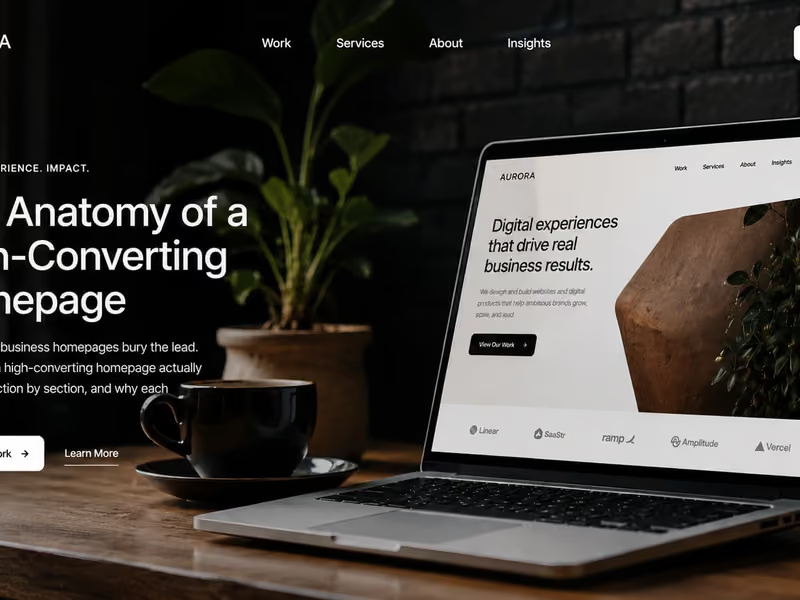
The homepage is the first handshake. The service pages answer the questions a prospect would raise in a sales conversation. The testimonials and project examples are the social proof a good salesperson would point to. The contact form is the close. For a detailed look at how these sections fit together, the anatomy of a high-converting homepage walks through each one.
Understanding how leads actually flow through a website is covered in depth in how service businesses get leads from their website.
What separates a selling website from an online brochure
A brochure tells you what a business does. A salesperson finds out what you need, responds to it specifically, and makes it easy for you to say yes.
The websites that generate leads consistently are built more like the second option.
-
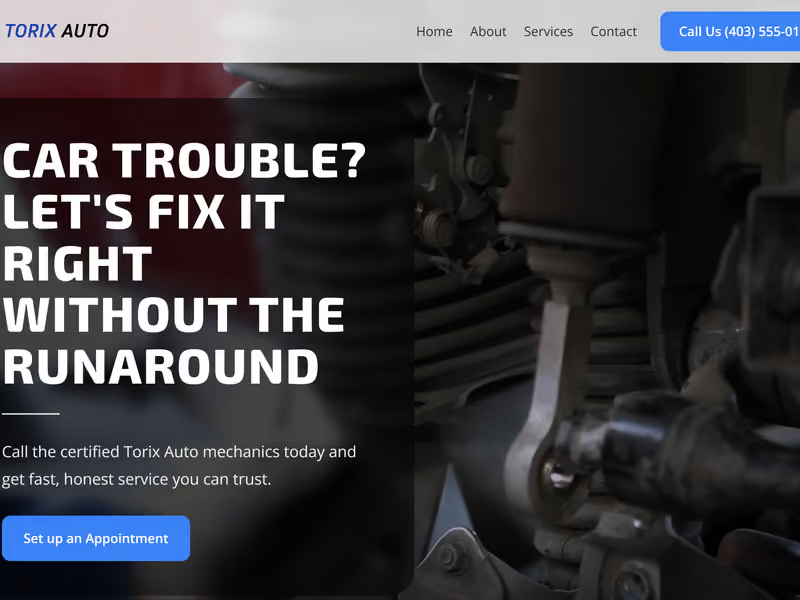
A specific headline above the fold. “Serving Calgary Since 2004” describes history, not a value proposition. A prospect scanning your homepage for three seconds needs to understand what you do, who you help, and why they should care, without scrolling. If your headline doesn’t do that, many visitors are already gone.
-
One visible call to action. Not a menu of options competing for attention. One clear invite: call, request a quote, book a consultation. The more decisions a visitor has to make, the fewer complete the step.
-
Real social proof near the top. A testimonial buried at the footer is not doing sales work. A specific review from a client describing a recognizable problem, visible before the fold, reduces the perceived risk of reaching out. Case studies with real project context are even more persuasive.
-
A contact path with minimal friction. Every required form field is a question a prospect has to answer before the conversation has even started. Name and a way to reach them is usually enough. Everything else can come after.
-
Speed on mobile. Most local service searches happen on phones. A page that takes six seconds to load loses visitors before they have read a single word. This is not a technical issue; it is a conversion issue.
These are the same decisions a good salesperson makes instinctively. A well-built website makes them deliberately, every time.
If your site gets traffic but produces few enquiries, why your website gets traffic but no leads goes deeper on diagnosing which step in the sequence is breaking down. For the complete conversion framework, conversion rate optimization for service businesses covers the strategy in full.
What happens when your website isn’t selling
Most service business websites are brochures. They have information on them. They look reasonable. But they were not built to convert.
The most common sign is that all leads come from referrals, and the website plays no role in them. Referral leads are valuable, but they are not scalable. They depend on who your existing clients know, how often your name comes up, and whether the timing happens to be right. A website that generates leads adds a second channel that compounds over time, independently of who you know.
Another sign is traffic without enquiries. If you can see visitors in Google Analytics or Search Console but almost none are contacting you, the site is reaching the right audience and losing them. That is a conversion problem, not a traffic problem, and our conversion optimization service addresses exactly that.
How to tell if your website is actually selling
You don’t need a full analytics dashboard to get a rough sense. These questions cover the most telling indicators.
- Where did your last five clients find you? If every one came through a referral, your website is not generating leads on its own.
- Does Google Search Console show visitors who didn’t convert? Organic traffic without corresponding enquiries is almost always a conversion problem, not a traffic problem.
- Can you find your phone number on mobile in under five seconds? Try it on a phone you haven’t visited the site from before. Most visitors won’t look harder than that.
- Does your homepage headline say what you do? Read it aloud as if you know nothing about the business. If it takes a second pass to understand, it’s costing you leads.
- When was the last time a client found you through your website? If you can’t name a recent example, that’s your answer.
For a more systematic look, a free website audit walks through the specific points where your site may be losing leads.
Frequently asked questions
Does my website still matter if most of my clients come from referrals?
Yes, for two reasons. First, most referral prospects still Google your name before reaching out, which means your website is either confirming or undermining the trust the referral already built. Second, referrals are not scalable. They depend on the size of your existing network and the conversations your clients happen to have. A website that generates leads adds a channel that doesn’t depend on either of those things.
What does a website need to actually generate leads?
At minimum: a clear headline that explains what you do and who you help, a visible way to contact you on every page, real social proof with specifics rather than generic praise, and a contact path with as few required fields as possible. Traffic matters too: a well-built website with no visitors generates zero leads. For most service businesses, a well-maintained Google Business Profile is the fastest path to relevant local traffic. Our lead generation website design service covers how we approach both sides.
How do I know if my website is selling or just existing?
The clearest signal is where your enquiries actually come from. If every lead arrived through a referral or a personal contact, your website likely isn’t contributing. If you can point to enquiries where someone found you through Google, it is working. If you are getting traffic but almost no leads, the conversion side is the problem. A free website audit will identify specifically where visitors are dropping off and what the highest-impact fixes are.
Can a simple website generate leads as well as a complex one?
Often yes, and sometimes better. A simple site with a clear message, real testimonials, and a visible phone number outperforms a complex site with an unclear value proposition and a buried contact form. The sophistication that matters is structural, not visual: clear message, one visible path to contact, real evidence of your work. The 7 essentials of a high-converting small-business website covers what actually moves results.
Your website is the only sales tool that works while you are on a job site, asleep, or with another client. Whether it does that job depends almost entirely on how it was built, not how it looks.
If you want a website built to generate leads from the start, our lead generation website design service covers exactly how we approach this. If the website already exists but the leads are not coming, our conversion optimization service diagnoses and addresses the specific points where visitors are dropping off. Or start with a free website audit and we will walk through what your site is doing well and where it is losing you leads.